

5 Month Sleep Schedule
|
|
Time to read 10 min

|
|
Time to read 10 min
By month five, you've stopped asking "is this normal?" and started asking "who is this little person?" Your baby has moved well past the newborn phase into something new: your baby is interactive and silly and smiling. Their own little personality emerges. They have opinions about caregivers, preferences about food and they're telling you elaborate stories in a language only they understand. If the newborn days felt long and hard (like some days feel for everyone), this is a welcome shift! Month 5 brings practical changes too. Solids are typically happening daily with sweet potato and peas in unexpected places and the pure joy of watching your baby discover that food exists. Teething may have arrived or is coming soon. Naps have settled into a rhythm you can almost predict. Sleep at night remains the beautiful, uninterrupted gift it's been for the past month. Weeks 21 through 24 are less about managing transitions and more about enjoying the payoff. Your baby is sleeping, eating and becoming a genuinely delightful human. This post covers what to expect across sleep, feeding, development and key reminders. The full schedule details and solid guidance live in the Moms on Call 0-6 Month Book and our online courses.
By 5 months, you're likely fully entrenched in the 4–6 month schedule or very close to transitioning to this routine if your baby is showing hunger cues closer to the 4-hour mark. Either way, sleep at this stage is looking predictable and, for many MOC families, truly restful.
Nighttime sleep remains solid at approximately 11–12 hours, a full night with no interruptions when your baby is healthy. Of course, when those colds and viruses come, sleep may be affected but keep the nighttime sleep routine and your baby will shift back into full nights when they are feeling well again. If you're still seeing consistent nighttime waking at this age, it's worth checking in: are daytime feeds full and focused? Is the sleep environment rock-solid? A MOC Consultant can help troubleshoot if something feels off.
Daytime naps are consolidating beautifully. You're likely seeing two main naps per day with a predictable rhythm: morning nap around 9:30–10:00 AM, afternoon nap around 12:30–1:00 PM, and possibly a brief catnap in the late afternoon. We’re aiming for 90 minute naps when possible knowing that some days that is just not in the cards. Some babies are spectacular nappers by 5 months; others are still working on it. Both are completely normal. What matters is that the timing is consistent and the sleep environment supports their best effort.
Bedtime stays around 7:00–7:30pm, with the day starting at 6:30–7:00am. This consistency is what allows your baby's internal clock to do its job.
At 5 months, you're juggling two feeding worlds: milk feeds are still the nutritional foundation of your baby's day and solids have become a regular and wonderfully messy part of the routine.
Milk feeding basics: Most 5-month-olds are on 5 feedings per day, typically taking 6–8 ounces per feeding (some days a bit more, some days a bit less, all normal). Breastfed babies typically spend 12–20 minutes per session. Bottle-fed babies are usually done in 10–15 minutes. Babies still need at least 24 ounces of breast milk or formula daily.
Solids reality: If you've introduced solids, your baby is likely eating 1-3 times each day, whatever you're offering. This is still very much the "practice and fun" phase. Food is not a nutritional necessity yet; milk is. Your baby is learning how food works, what different flavors taste like and how to manage a spoon in their mouth. Some bites go in. Many go on the shirt, the high chair, your face. All of this is exactly right.
Tips for feeding success: Use soft-tipped spoons, be patient with the gagging reflex and let your baby set the pace. Some babies are enthusiastic about solids while others are skeptical. Both are fine. Offer a variety of single-ingredient foods, introduce one new food every few days and lean on MOC's Baby Food Calendar to keep yourself organized.
Teething comfort: If gnawing has started, offer a variety of textured teething toys. Try some chilled and some at room temperature to see what is more soothing for your baby. Teething rings, silicone teethers and even a damp washcloth that has been put in the freezer can all be helpful for those sore gums. Watch for excessive drooling, swollen gums or fussiness that goes beyond the usual, and check in with your pediatrician if something feels off.

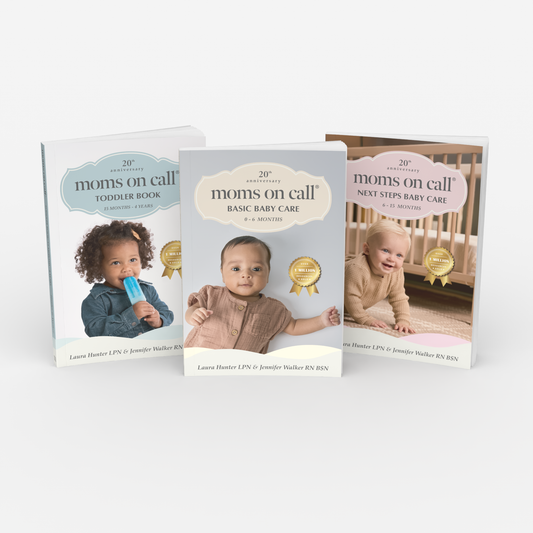
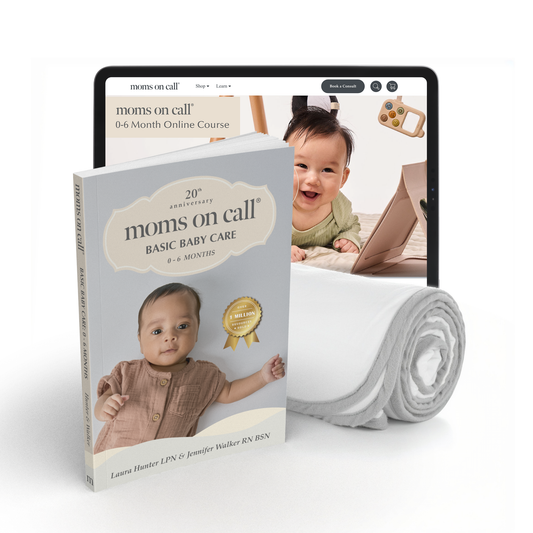
Get the Full Schedule and More
Our 0-6 Month Book is trusted by over 1 million families.
Order the BookRolling in all directions. Your baby can roll both ways confidently and is starting to use rolling as intentional movement instead of just a reflex.
Sitting with support is getting stronger. Many 5-month-olds can sit with minimal support and bear significant weight on their legs when held upright. Independent sitting is coming in the next month or two.
Reaching and grabbing is purposeful and getting powerful. Your baby knows exactly what they want and will work to get it. Time to baby-proof any surfaces within arm's reach.
Vocalizing is becoming a conversation. Your baby is "telling stories" with long strings of babbles, coos and consonant sounds that sound like they have genuine meaning. Respond to every story. They love being heard.
Language recognition is real. Your baby turns toward their name, responds to tone changes and starts to understand that sounds mean things. The more you talk to them, the faster this accelerates.
Foot dexterity is improving. They're not just discovering their feet anymore. They're grabbing them, examining them intensely and sometimes attempting to get them in their mouth. The precision is remarkable.
Teething may begin in earnest. Some babies start with visible teeth around this age; others have months to go. Either way, the teething process (drooling, gnawing, swollen gums) can start well before the tooth appears.
Personality explosion. Your baby laughs at specific jokes, shows preferences (yes to you, maybe not to strangers) and has opinions about everything. This is the month when most parents stop thinking "what is my baby doing?" and start thinking "who IS this person?"
Object permanence is budding. If a toy falls out of view, your baby may start to look for it. Peek-a-boo becomes exponentially more fun because they're now understanding that you're still there behind your hands.
Schedule transitions are on the horizon but not urgent. When your baby is staying awake comfortably for around 2.5 hours and not showing hunger until closer to the 4-hour mark, your baby will be happy on the 4-6 month schedule.
Teething is a marathon, not a sprint. Some babies cut their first tooth at 5 months, others won't until month 7 or 8. The discomfort can start weeks or even months before the tooth appears. Comfort measures that work one week might not work the next. Keep a variety of tools on hand and stay patient.
Solids are still supplementary. Your baby's primary nutrition is coming from breast milk or formula. Solids are for exploration and learning. Don't worry if your baby eats a teaspoon or rejects something outright. Keep offering, stay relaxed and let them lead the pace.
Baby-proofing is now critical. A rolling, reaching 5-month-old is mobile in ways you might not have anticipated. Get down to your baby's level, look at what's within reach and secure anything hazardous. Cords, outlets, small objects, unstable furniture: all of it needs attention now.
Clinginess is developmentally normal at this age. Your baby knows you better now and may be less interested in being held by strangers or separated from you, even briefly.
Sleep regressions are not on the agenda. You've made it past the 4-month breakthrough. If sleep takes a hit at 5 months, it's usually due to teething, illness or a developmental leap, not a regression cycle. Stay consistent and it typically resolves quickly.
You're in the fun stage now. Yes, there are still challenges. But this is the stage where your baby laughs at your silly faces, becomes interested in the world around them,and starts to feel like a real person rather than a tiny dependent. Soak it in!
Five months in and you're not learning a schedule anymore. You’ve got that down and now you're celebrating a personality. The work you put in those early months is written all over this kid: they're secure, they're sleeping, they're thriving. The next few weeks will bring you closer to the back half of the first year and new skills, new challenges and whole new kinds of fun.
Keep leaning on your routine. It's the foundation for everything else.
Book a consultation with one of our Certified Moms on Call Consultants!
Check out these blogs for more timely support for your 5 month old baby.
Feeding Guidelines for the First 6 Months
Moms on Call's 5 Month Old Sleep Schedule
Transitioning to the 4-6 Month Routine without Starting Solids
Favorite Feeding Products for Starting Solids
Baby Food Introduction Calendar
Transitioning to the Next Schedule
Prior Month Schedule (4 Month Sleep Schedule)
Teething discomfort can definitely disrupt sleep at this age but it's not always the cause. Before assuming teething, check the basics: are daytime feeds still full? Is the sleep environment cool, dark and consistent? Has anything changed (illness, travel, schedule shift)?
Teething typically shows other signs: visible drooling, swollen gums, chewing on hands and toys and possibly a slight fever. If you're seeing nighttime waking plus other teething signs, offer teething toys, cold washcloths, and extra comfort. If it's only the sleep disruption and no other signs, work through the basics first and if it persists, check in with your pediatrician to rule out illness.
Your 5-month-old should still be getting the majority of their nutrition from breast milk or formula. Solids at this stage are offered for exploration and learning, not for nutrition. One, two or three servings per day is completely normal. So is offering solids and having your baby reject them. Serve roughly a tablespoon to a few tablespoons of food per feeding, use a soft-tipped spoon, and follow your baby's cues. Some babies are enthusiastic while others are skeptical. Both are fine. The "main event" is still milk. Solids are the supporting player.
Nap variability at 5 months is completely normal. We are aiming for 90 minute naps when possible and giving babies time to work out the 45-minute nap intruder. You can't force a long nap; you can only provide the opportunity. If naps are genuinely brief across the board (15–20 minutes), double-check the dark room, white noise and whether your baby is rolling or transitioning between sleep cycles. If everything looks good, some babies are just shorter nappers and that's okay. Our short naps mini course can help too!
This is healthy attachment development. At 5 months, your baby knows you better and understands separation. They prefer you and may be hesitant with strangers or unfamiliar people. This is a sign of secure attachment, not a regression. It's normal, temporary and actually a really positive thing. Give your baby the security they need by staying consistent and being the person they turn to. Introduce new people slowly and always with you present. This phase typically peaks around 6–9 months and gradually improves from there.
At Moms on Call, we focus on what's actually happening with your individual baby rather than expecting regressions by calendar date. A true developmental phase that disrupts sleep happens when your baby is working on a new skill like sitting up, rolling, or increased awareness. Not all babies hit this at the same time. If sleep is good right now, enjoy it. Stay consistent with your routine, keep daytime feeds full, and only make changes if your baby actually needs them. You won't need to "prepare" for a regression, just stay responsive to what your specific baby is doing.

Laura Hunter, LPN and Jennifer Walker, RN, BSN
Co-Founders of Moms on Call, Pediatric Nurses and Moms to 8 kids between them, Laura Hunter and Jennifer Walker created Moms on Call to simplify parenting. Through their books, online courses, podcast and content, they help parents everywhere navigate the first four years with confidence and better sleep.